WMS Software for Manufacturing Plants & 3PL
Warehouse management system for manufacturing plants and multi-client 3PL distribution centres: one current state and location for every object, directed putaway that remembers its own suggestion, and cycle counting that runs alongside picking.
Watch with transcript →1:01 · captions · narrated demo
Software Modules
Explore the WMS Software
Screens from the running system — click a module to preview

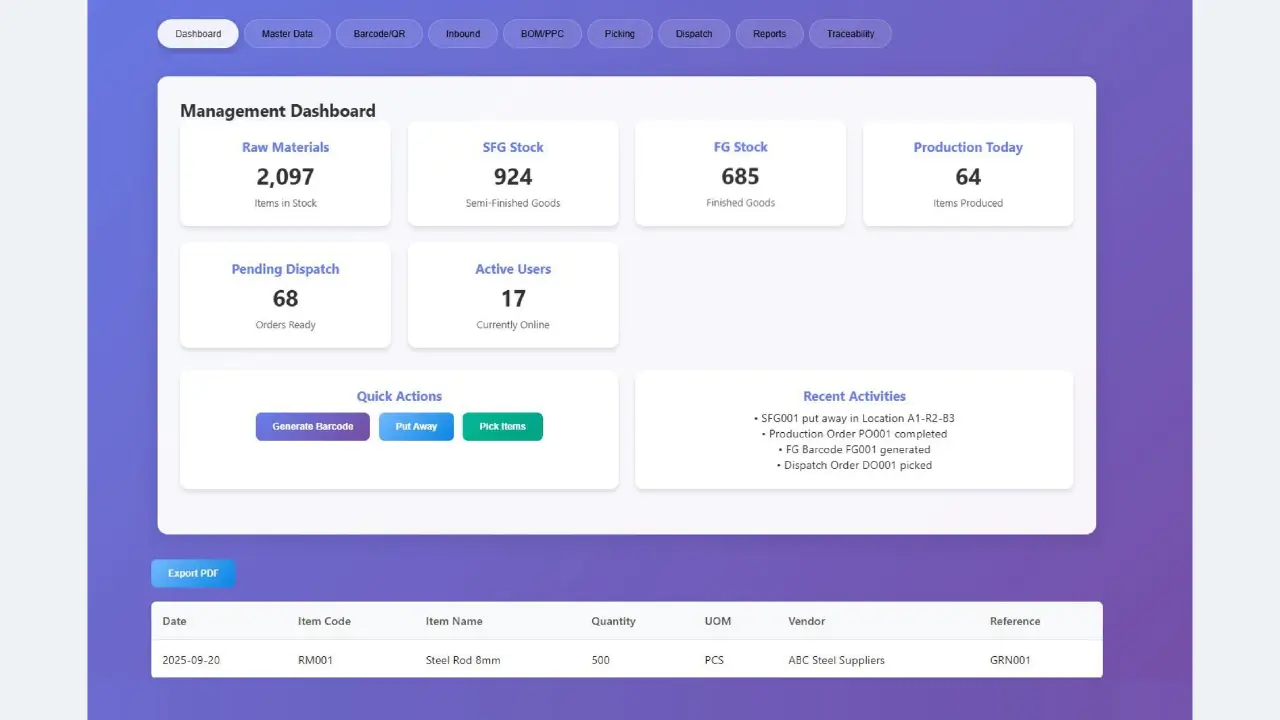
Management Dashboard
Live stock position across raw materials, semi-finished and finished goods, with production today, pending dispatch, active users, and quick actions for barcode generation, put-away and picking.
Warehouse management system
What a warehouse management system actually is
Every serious candidate has the features. What separates them is whether the record stays true.
WMS software is usually compared feature by feature: wave picking, cluster picking, hazmat handling. Those comparisons rarely predict which system a facility ends up routing around. A narrower definition does: a warehouse management system is a ledger asserting, for each physical object, one current state and one current location. Receiving, putaway, picking, dispatch and counting are all guarded transitions on that pair.
| Transition | State | Location |
|---|---|---|
| Goods receipt | unset → raw material | unset → receiving area |
| Putaway | unchanged | receiving area → a typed storage location |
| Issue to production | unchanged | storage → line side |
| Production completion | raw → semi-finished, or semi-finished → finished | line side → a location of the matching type |
| Pick | unchanged | storage → staging |
| Dispatch | finished goods → shipped | staging → outbound |
| Cycle count | unchanged | unchanged — writes an observation, and an adjustment only on variance |
The last row is what separates a ledger from a database. A count is an observation about the record, not an instruction to it; the adjustment it may cause is a separate, attributable transition. And because stock is transformed inside a manufacturing plant — raw, semi-finished, finished — the state coordinate does real work here, which is why this WMS suits plants as well as distribution centres.
A warehouse routes around its system when the system's answer stops being worth checking. That is a property of the record, not of the feature list.
Record integrity
Four ways a WMS record goes wrong, and why net variance hides two of them
The invariant has four obligations. Each failure looks different on the floor.
Every physical movement writes exactly one transition; no transition is written without a movement; a transition is rejected unless it resolves against governed master data; and a transition that would break a capacity or type rule is refused rather than recorded with a warning.
| Violated obligation | What it looks like | Facility response |
|---|---|---|
| Movement without transition | Picker cannot find stock the system shows | Physical search, then an adjustment nobody can attribute |
| Transition without movement | System shows stock in a location that is empty | Same search, same adjustment, opposite sign |
| Ungoverned resolution | Free-text location or item on a record | The record cannot be validated or aggregated, so it drops out of reports |
| Guard downgraded to warning | Over-capacity or wrong-type location accepted | Stock stored where nobody looks for it; found at the next count |
The first two produce compensating errors that a net reconciliation cancels. A facility measuring only net variance can hold both faults indefinitely and conclude its records are sound. This is also why the location master carries a type and a capacity: those two fields turn putaway from advice into arithmetic.
Directed putaway
What an override actually costs, and why the system must remember its suggestion
Travel dominates picking time, so putaway decides the cost of every pick that follows.
The order-picking literature is settled on one finding: walking between pick faces, not picking, is where the time goes. Directed putaway assigns each incoming unit using velocity, size, weight, hazard class and refrigeration. Ad-hoc putaway lets an operator confirm the suggestion or choose an approved alternative — useful in a receiving surge, and a real trade of throughput now against travel on every later pick.
override cost = pick frequency × extra distance, summed over overridden units
Because the system records the location it suggested alongside the one used, this is a number a manager can report, not an argument.
Worked example: one week of receiving-surge overrides
120 putaways are overridden. 18 are fast movers picked 40 times a month; 102 are slow movers picked 1.5 times a month. Each chosen location is 22 metres further than the directed one. Fast movers add 18 × 40 × 22 = 15,840 m of travel a month; slow movers add 102 × 1.5 × 22 = 3,366 m.
Fifteen per cent of the overrides generate eighty-two per cent of the cost. Allowing overrides only for slow movers keeps 102 of the 120 — nearly all the surge relief — while removing four fifths of the penalty.
Cycle counting
Cycle counting is measured by how long a wrong record survives
The count rate matters less than the time an error stays in the system.
Counts here run continuously alongside picking, triggered by stock class, by time since the last count, and by picker discrepancy — without freezing operations. Expected staleness under scheduled counting is half the count interval, shortened further wherever pickers detect discrepancies. That detection concentrates exactly where errors matter: a fast-moving face is visited many times a period, so an error in it is found almost at once.
On a 4,000-location warehouse, an annual freeze count leaves errors undetected for about six months on average. Sixty count tasks a working day brings that to about seven weeks, and picker-triggered discovery on the fast-moving third of locations takes it under two weeks.
| Continuous cycle count | Periodic full count | |
|---|---|---|
| Controls | how long a wrong record survives | completeness of coverage on one date |
| Coverage | biased toward what is picked | every location, including those nobody visits |
| Cost | absorbed into normal operations | operational shutdown |
| Blind spot | slow-moving and dormant stock | everything between counts |
| Evidence value | operational accuracy between counts | statutory position at a stated date |
The blind spots are complementary, so a facility usually needs both. High accuracy from continuous counting is an argument for sampling the periodic count, not for abandoning it — see annual inventory tagging.
3PL and multi-client
The ceiling is the number of rule sets, not the size of the building
Why a warehouse outgrows its system, and the one onboarding result attributed to this module.
One client is one set of putaway rules, one pick path, one packing flow. Three clients sharing docks and aisles is three rule sets plus the interactions between them. A system where client is a filter rather than a first-class dimension expresses those interactions as exceptions. So the buying test is not "does it support multiple clients" but: ask for two clients with contradictory putaway rules competing for the same aisle.
A multi-client third-party logistics operator deployed MileSoft warehouse modules across a distribution centre. Its previous system had no interface, so each client integration took roughly six weeks of custom data plumbing. After deployment, new-client onboarding is reported at eight days, because integrations became standard mappings against a stable interface rather than per-client pipelines.
One operator, no sample
It is a single operator's experience; no number of clients is stated.
The baseline belongs to the old system
Six weeks was a property of a system with no interface. An operator whose current system already has a stable interface should expect a much smaller change.
Other results in that deployment belong to other modules
The accuracy gain from 91% to 99.4% is attributed to Inventory Tracking, and the dock-idle and dwell results to Loading Dock Management with Truck Turnaround. None of them is claimed for WMS.
The test is not whether an interface exists. It is whether the same endpoint served the last three clients unchanged. The full account is in the warehouse case study.
Evaluating WMS software
Eight questions to put to any warehouse management system
Each is answerable by demonstration on a running system — including ours.
| # | Dimension | Ask the vendor to demonstrate |
|---|---|---|
| D1 | Governed destinations | Attempt a putaway to a location that is not in the master. Is it accepted? |
| D2 | Capacity as a guard | Put away into a location already at capacity. Refused, or warned and recorded? |
| D3 | Type as a guard | Store a unit in a location typed for a different stock state. What happens? |
| D4 | Suggested against used | Does the record keep both the location the system directed and the one chosen? |
| D5 | Override cost visible | Can the system report the travel cost of last month's ad-hoc putaways? |
| D6 | Count as observation | Does a count write an observation and a separate adjustment, or overwrite the quantity? |
| D7 | Staleness reported | How long, on average, does a wrong record survive before it is found? |
| D8 | Contract stability | Did the same integration endpoint serve the last three clients unchanged? |
D4 is the cheapest question and the most revealing. A system that discards its own suggestion cannot be evaluated, improved, or held to account for the slotting it produced.
Standards referenced: ISO/IEC 19987 (EPCIS) and 19988 (CBV), GS1 General Specifications and SSCC, ISO/IEC 15459-1, ISO 22400-2, IEC 62264-3, ISO 28000. Derivations and worked examples are in the WMS method paper.
Features
Key Features
Built-in capabilities that set our software apart
Transition ledger
every object holds one state and one location; receipt, putaway, pick, dispatch and count are guarded transitions
Typed locations with capacity
zone, rack and bin codes that refuse a wrong-type or over-capacity putaway instead of warning
Three stock states
raw material, semi-finished and finished goods, for plants that transform material as well as store it
Directed and ad-hoc putaway
the suggested location is stored beside the one used, so override cost is reportable
Continuous cycle counting
triggered by stock class, time since last count and picker discrepancy, with no operational freeze
Benefits
Key Benefits
What your team gains from adopting our platform
Testimonials
What Our Clients Say
Trusted by industry leaders across manufacturing, HVAC, and logistics.
"The software features, such as real-time monitoring and alerts, have proved invaluable in optimizing machine operations. MileSoft team's professionalism, technical expertise, and dedication to meeting our requirements have been impressive."
FAQ
WMS Software — FAQs
Answers to the most common questions about this product. Need more? Book a demo or reach out via Contact.
What makes this a WMS rather than inventory software?
Is it suitable for multi-client 3PL operations?
How long does onboarding a new client take?
Does it support both directed and ad-hoc putaway?
Can cycle counts run without stopping operations?
Does the WMS include real-time inventory tracking?
What master data does the WMS manage?
Explore More
Related Products
Complementary tools teams often pair with this solution
Related Reading
Go deeper
Explore the long-form story behind this product.
One Object, One State, One Location: The Transition Ledger at the Centre of a Warehouse Management System
Architecture, Computational Methods, and Field Evidence from MileSoft Warehouse Management
Read the paperRead the full WMS Software for Manufacturing Plants & 3PL deep-dive
Read articleSee how MileSoft delivers in Warehouse
Read case studySee your savings in under a minute
Estimate the time and cost this tool could give back — free, instant, no sign-up.
Test a WMS on the questions that decide it
Bring your hardest putaway rule and two clients who compete for the same aisle. We will run them on the system and show what it refuses, what it records, and what it reports.