Truck Terminal Scheduling & Turnaround Time (TAT) Software
Truck terminal scheduling software for plants, DCs and truck terminals: gate entry, queue sequencing and slot reservation, with dwell measured as four intervals — gate, yard queue, dock service and exit — so you can see which one is actually your constraint.
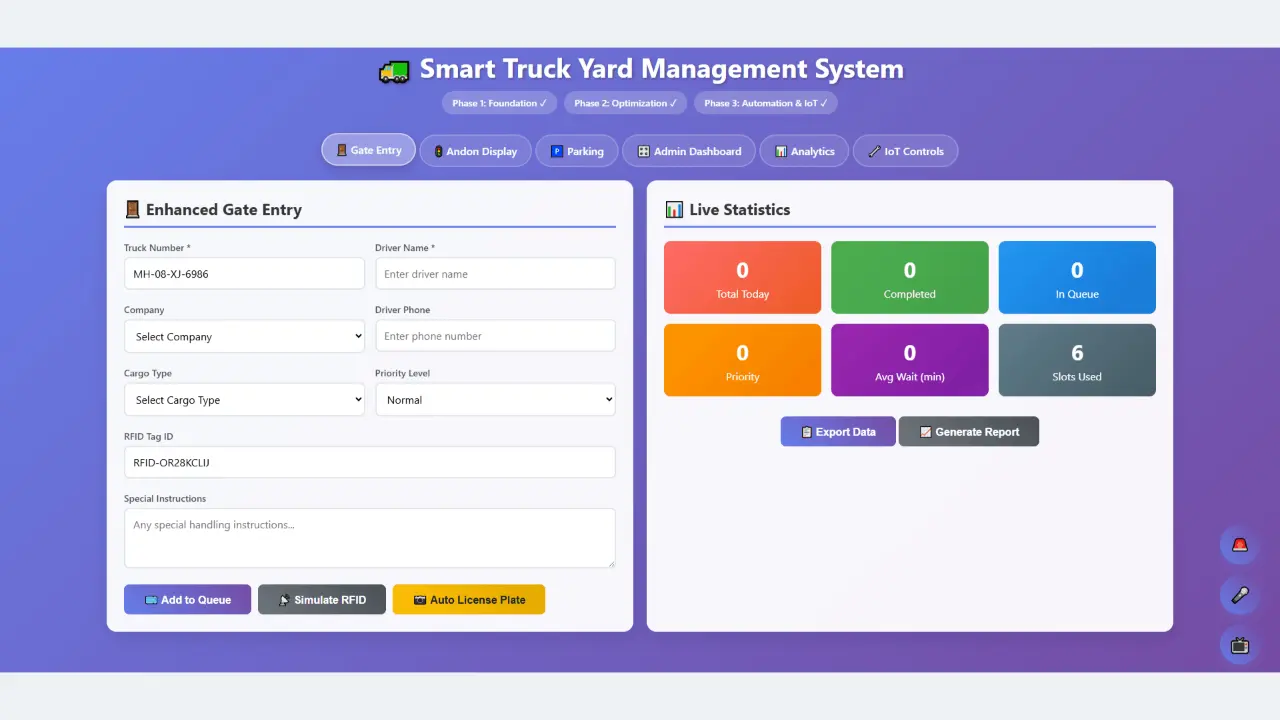
Watch with transcript →1:03 · captions · narrated demo
Software Modules
Complete Truck Turnaround Modules
Explore our comprehensive suite of logistics tools — click any module to preview

Gate Entry
Digitally process incoming trucks with priority handling and live tracking statistics.
Truck turnaround time
Two sites, one dwell figure, opposite purchases
Gate-to-gate dwell is what a carrier bills against. It is also four intervals with four different owners.
Two sites reporting the same three-hour dwell can need opposite things. One with two hours in the yard queue needs sequencing; one with two hours at the door needs load readiness. Buying the wrong one is easy, and in this field it is common — because no single intervention shortens more than one of the four intervals, a combined dwell figure cannot direct an investment.
| Interval | Measured between | Owner | What shortens it |
|---|---|---|---|
| Gate processing | Arrival → identity resolved, joins queue | The gate | Automatic identity capture |
| Yard queue | Joins queue → called to a door | The sequencing policy | Queue discipline, priority design, reservation policy |
| Dock service | At the door → released | The door and the load | Load readiness, door capability, equipment |
| Exit | Released → clears the gate | The gate again | Paperwork removal, automatic departure capture |
The decomposition costs nothing. Every endpoint is already an event the system writes, so reporting four intervals instead of their sum needs no new instrumentation.
It also sets honest expectations. MileSoft’s own product material puts the manual gate step that automatic plate recognition removes at three to five minutes per vehicle — and that acts on the gate interval and nothing else. A site whose problem is in the yard queue should expect three to five minutes from plate recognition, not a transformation.
Yard sizing
Why more parking rarely fixes a gate queue
Little's Law says exactly what extra parking buys.
trucks in the yard = arrival rate × dwell
It holds in steady state whatever the arrival and service distributions. A site accepting twelve arrivals an hour at a ninety-minute dwell needs eighteen slots, and no amount of goodwill changes that.
The same relation says the uncomfortable part: a yard enlarged without reducing dwell simply holds more trucks for the same time. The queue is accommodated, not shortened, and the detention clock runs identically. Parking is sometimes the right purchase — a site must physically hold the trucks it has accepted — but it moves none of the four intervals.
Why the pressure arrives suddenly is a queueing result too. Waiting time rises with utilisation and with variability, steeply as door utilisation approaches one. A site at 95% door utilisation is not slightly worse than one at 80%; it is in a different regime, and the difference between a manageable morning and a queue to the road is a few percentage points.
Terminal scheduling
What a priority lane and an early reservation really cost
Both feel like service improvements. Both are redesigns of the queue.
Priority lanes
The gate captures a priority level before a vehicle joins the queue, so the system can run a priority discipline. Queueing theory is blunt about what that does:
Priority creates no capacity. The load-weighted mean wait across all classes is unchanged by the discipline. Priority only decides who bears the wait.
The cost falls hardest on the lowest class, and non-linearly. As overall utilisation rises, the bottom class's wait diverges much faster than the average does.
A priority class big enough to matter commercially is big enough to hurt. A promise to a carrier carrying a third of the volume is not a courtesy — it is a re-design of the queue.
So price a priority lane before granting it. Every term is available from the gate’s own history, which means the delay a proposed lane imposes on ordinary traffic is a number that can be put in front of the person about to promise it.
Slot reservation
effective slots = total slots − arrival rate × mean reservation lead time
A reserved slot is committed to a truck that has not arrived, so it cannot go to one that has. The cost of the promise is proportional to how far ahead it is made — which points to a lead time tuned against how reliably carriers arrive, rather than either extreme. A no-show holds its slot until the reservation expires, which is why reservation policy and carrier punctuality belong in the same system.
A yard reporting high availability while trucks queue at the gate is usually reserving too far ahead. The slots are not free, they are promised — and the queue outside is paying for the certainty inside.
Field evidence
What the published deployment shows, and what it does not
One documented result, reported with the three caveats that belong to it.
A multi-client third-party logistics operator whose dock and yard scheduling ran on messaging apps and paper trip sheets deployed MileSoft warehouse modules across a distribution centre. It reported average gate-to-gate dwell falling from 3 hours 10 minutes to 1 hour 20 minutes, and dock idle time falling by 38%.
The mechanism named in that account is re-sequencing: when a truck arrives early, it fills a door that would otherwise idle instead of being held against a static appointment. That shortens the yard-queue interval and door idle at the same time, which is why the two results moved together.
Shared attribution. Both figures belong to Truck Turnaround and Loading Dock Management working on one shared yard state. Neither is this product's result alone.
A poor starting point. The baseline was coordination by messaging app and paper, so the improvement measures distance from an unusually weak position.
A mean, not a distribution. Average dwell falling from 190 to 80 minutes says nothing about the tail — and the tail is where detention charges are incurred.
The full account is in the warehouse case study. The screens elsewhere on this page come from a demonstration instance; they show what the software models, not how long a real truck waits in a real yard.
Evaluating yard software
Eight questions to put to any truck scheduling system
Each is answerable by demonstration — including by us.
| # | Dimension | Ask the vendor to demonstrate |
|---|---|---|
| D1 | Four intervals | Report last month's dwell split into gate, yard queue, dock service and exit. Can it? |
| D2 | Generated endpoints | Is any of arrival, queue entry, dock call or departure typed by a person? |
| D3 | Attribution | For one overrun, can the system say whose delay it was without a manual investigation? |
| D4 | Priority priced | Before granting a carrier a priority lane, can the system state the delay it adds to everyone else? |
| D5 | Re-sequencing | A truck arrives ninety minutes early to an idle door. Does the queue re-sequence, or does the appointment hold? |
| D6 | Reservation lead time | How far ahead is a slot committed, and what fraction of the yard is held in reservation right now? |
| D7 | Distribution, not mean | Does dwell reporting show a percentile, or only an average? |
| D8 | Shared yard state | Do the gate and the dock read and write the same yard state, or exchange it? |
D5 is the one the published deployment result actually turns on. A system that holds an early truck against a static appointment while a door idles is not coordinating; it is scheduling — and those are different jobs.
Standards referenced: ISO/IEC 19987 (EPCIS) and 19988 (CBV), GS1 SSCC, ISO/IEC 15459-1, ISO 28000, ISO 22400-2. Derivations and worked examples are in the truck turnaround method paper; for the door side of the same yard, see loading dock management.
Features
Key Features
Built-in capabilities that set our software apart
Gate identity three ways
keyed at the gatehouse, read from an RFID tag, or recognised from the number plate
Priority at the gate
captured before the vehicle joins the queue, where it costs least
Slot pool
free, reserved and occupied slots, assigned manually or automatically
Four-interval dwell
gate, yard queue, dock service and exit, each from system-generated timestamps
Driver-facing display
queue position and slot shown to drivers, with per-carrier turnaround reporting
Benefits
Key Benefits
What your team gains from adopting our platform
Testimonials
What Our Clients Say
Trusted by industry leaders across manufacturing, HVAC, and logistics.
"The software features, such as real-time monitoring and alerts, have proved invaluable in optimizing machine operations. MileSoft team's professionalism, technical expertise, and dedication to meeting our requirements have been impressive."
FAQ
Truck Terminal Scheduling & Turnaround Time (TAT) Software — FAQs
Answers to the most common questions about this product. Need more? Book a demo or reach out via Contact.
What actually counts as turnaround time?
Will adding parking fix our gate queue?
How does automatic plate recognition help?
Can carriers see their own position?
How is shift handover handled?
Is this truck terminal scheduling software?
Explore More
Related Products
Complementary tools teams often pair with this solution
Related Reading
Go deeper
Explore the long-form story behind this product.
Dwell Is Four Intervals: Queue Discipline, Slot Reservation, and Where a Truck Actually Waits
Architecture, Computational Methods, and Field Evidence from MileSoft Truck Turnaround
Read the paperRead the full Truck Terminal Scheduling & Turnaround Time (TAT) Software deep-dive
Read articleSee how MileSoft delivers in Warehouse
Read case studySee your savings in under a minute
Estimate the time and cost this tool could give back — free, instant, no sign-up.
Find out which dwell interval is costing you
Bring a week of gate records. We will split your dwell into gate, yard queue, dock service and exit, and show where the time actually goes.