ERV Selection Software for Energy Recovery Ventilators
Energy recovery ventilator selection that treats effectiveness as a function of the operating point, checks the ASHRAE 90.1 enthalpy recovery ratio, and subtracts the fan power recovery costs — for wheel and plate devices alike.
Watch with transcript →1:08 · captions · narrated demo
Software Modules
Complete ERV Software Modules
Screens from the running system — click a module to preview

Secure Login
Secure and seamless sign-in to access your workspace.
Energy recovery ventilator selection
ERV effectiveness is a ratio evaluated at a state, not a device constant
A catalogue figure describes one condition. The unit runs for a year of others.
Effectiveness varies with the ratio of the two airflows, with the driving temperature difference, and — for a total-energy device — with the humidity difference. A unit that meets a summer design condition can recover materially less across the year. Quoting effectiveness without the state is like quoting a chiller's efficiency without saying at what load.
A defensible selection resolves four questions a single figure conflates: sensible recovery at design; latent recovery, a separate transport mechanism with its own effectiveness; the pressure drop on each stream and the fan power it costs; and what happens in the hours when frost control reduces or suspends recovery.
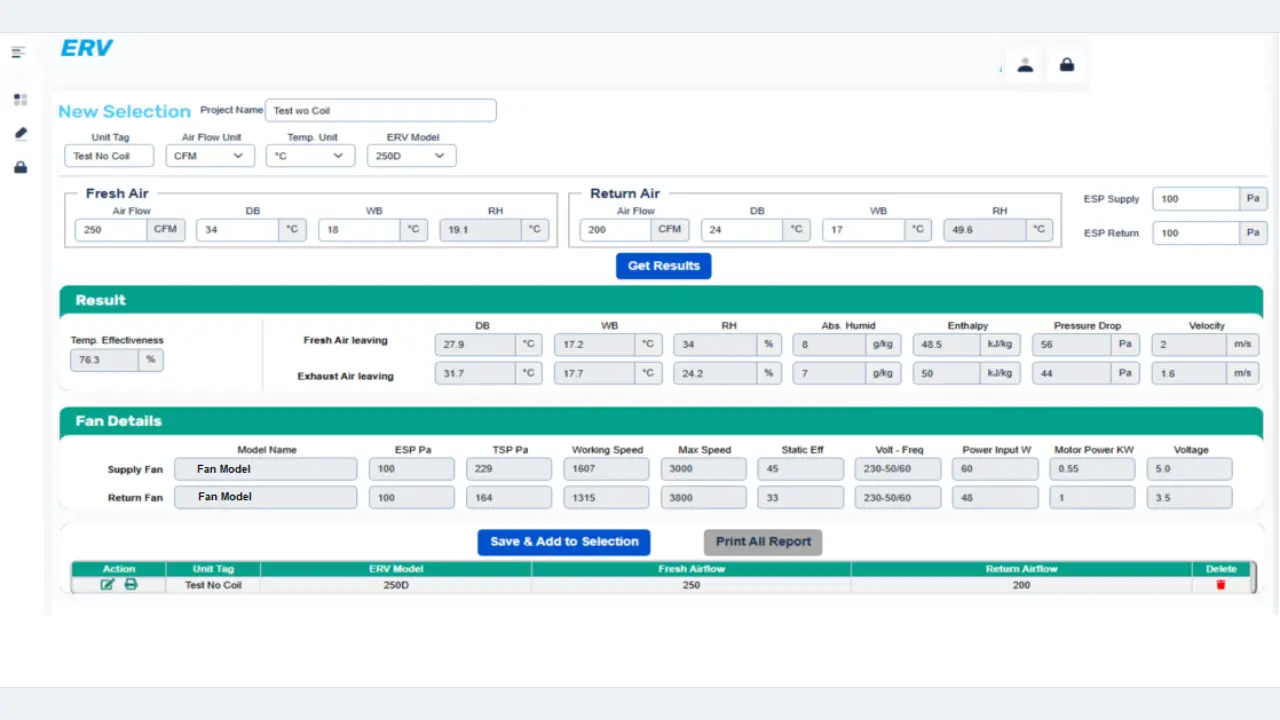
So the engine takes both entering air states and both flows, with the airflow ratio as an input rather than an assumption of balance — unbalanced flow is the normal case wherever toilets and kitchens exhaust. It returns the full leaving state on both streams (dry bulb, wet bulb, relative and absolute humidity, enthalpy), sensible, latent and total effectiveness, supply- and exhaust-side pressure drops reported separately as AHRI 1060 rates them, and both fans sized.
The leaving state matters beyond the recovery figure. A recovery device changes the air presented to whatever follows it, so a downstream AHU coil must be rated at the post-recovery state. A tool that reports only energy recovered leaves the next selection nothing to work from.
Wheel vs plate ERV
Wheel or plate: the enthalpy recovery ratio decides, not preference
ASHRAE 90.1 sets the threshold as an enthalpy ratio, and enthalpy includes a latent term.
ANSI/ASHRAE/IES Standard 90.1 requires energy-recovery systems above defined thresholds to reach a minimum enthalpy recovery ratio of 50% at cooling conditions and 60% at heating conditions where both apply. Because it is an enthalpy ratio rather than a temperature ratio, a sensible-only device cannot reach it in a humid climate at any temperature effectiveness.
Worked example: identical temperature effectiveness, 71% against 29%
Outdoor air at 38 °C and 0.0182 kg/kg (about 85.0 kJ/kg); return air at 24 °C and 0.0093 kg/kg (about 47.8 kJ/kg); balanced flow. A total-energy wheel with 0.75 sensible and 0.68 latent effectiveness leaves supply air at 27.5 °C and 0.01215 kg/kg — about 58.6 kJ/kg — so the enthalpy recovery ratio is 26.4 ÷ 37.2 = 71%, well above the 50% threshold.
A sensible-only plate with the same 0.75 temperature effectiveness also leaves the air at 27.5 °C, but at the original 0.0182 kg/kg — about 74.2 kJ/kg. Its ratio is 10.8 ÷ 37.2 = 29%. It fails a requirement it was never able to address.
In a dry climate the latent term is small, the enthalpy ratio approaches the temperature ratio, and a fixed plate can satisfy it. In a humid one it cannot. The same distinction separates an ERV, which recovers total enthalpy, from an HRV, which recovers sensible heat only. The climate decides.
Net energy
Is the energy recovery worth its fan power?
Recovered heat and fan power are not in the same currency. Comparing them directly is the most common error.
net saving = thermal recovery ÷ plant COP − (supply fan power + exhaust fan power)
Thermal energy a chiller would otherwise supply at a COP of 4 costs a quarter of its magnitude in electricity. Fan power is electricity outright. AHRI 1060 reports the two pressure drops separately precisely so both fans can be computed.
Worked example: a strong result, then a marginal one
At 2.0 m³/s per stream the wheel above recovers 63.4 kW of heat — 15.85 kW of avoided electrical demand at COP 4. Pressure drops of 220 Pa supply and 200 Pa exhaust at 0.60 fan efficiency cost 1.40 kW. Net saving: 14.45 kW.
Now a device at the same effectiveness but 480 Pa and 450 Pa costs 3.10 kW, on a mild-climate project where the enthalpy difference is a third as large. Recovery falls to about 21.1 kW, avoided demand to 5.28 kW, and net saving to 2.18 kW — the fans have eaten more than half the benefit.
A high-effectiveness, high-resistance device can be a net loss on a mild-climate project with an efficient chiller — exactly where a single-figure comparison would recommend it most confidently.
Frost control
ERV frost control is an energy debit, not a footnote
Frost mitigation costs energy in exactly the hours recovery looks best.
In cold climates, exhaust moisture condenses and freezes on the exchanger when the supply-side surface drops below freezing. Every mitigation has a cost: preheat consumes energy directly; bypass reduces recovery while it runs; recirculation and wheel-speed modulation reduce effectiveness rather than suspending it.
annual recovery = Σ over weather bins (hours × recovery × availability) − frost-control energy
The consequence for selection: the device with the highest rated effectiveness is not necessarily best in a cold climate. A high-effectiveness wheel drives the supply-side surface colder and frosts sooner than a moderate one. The comparison has to be made on delivered annual energy, not on the rating.
Why single-figure selection fails
Five failure modes of single-figure ERV selection
Each one makes a unit look better on paper than it performs in the building.
Rated effectiveness treated as annual
The design-point figure is applied across the year, ignoring that effectiveness rises at reduced airflow and varies with the driving difference.
Sensible figure against an enthalpy requirement
A temperature effectiveness is quoted where ASHRAE 90.1 asks for an enthalpy recovery ratio, which a sensible-only device cannot meet in a humid climate.
Fan power omitted
Pressure drop is never turned into fan power, so a high-effectiveness, high-resistance device looks strictly better than a moderate one.
Frost ignored
Cold-climate hours with frost control active are missing from the annual estimate.
Exhaust air transfer unconsidered
For rotary devices, carryover and purge are not evaluated — which matters where the exhaust stream is contaminated.
Evaluating ERV software
Eight questions to put to any ERV selection software
Each is answerable by demonstration — including by us.
| # | Dimension | Ask the vendor to demonstrate |
|---|---|---|
| D1 | Operating-point effectiveness | Change the airflow ratio. Does the reported effectiveness move, or is it a device constant? |
| D2 | Three ratios | Are sensible, latent and total effectiveness reported separately, as AHRI 1060 rates them? |
| D3 | Leaving state | Does the output give the full psychrometric state of both streams, or only recovered energy? |
| D4 | Separate pressure drops | Are supply- and exhaust-side pressure drops reported separately, and both fans sized? |
| D5 | Net gain | Is thermal recovery converted by plant COP before fan power is subtracted? |
| D6 | Code check | Is the enthalpy recovery ratio checked against the ASHRAE 90.1 threshold, not a temperature ratio? |
| D7 | Frost accounting | On a cold-climate project, does the annual estimate carry frost-control energy and reduced availability? |
| D8 | Downstream handoff | Can the post-recovery state pass to a coil selection, or must it be re-entered by hand? |
D1 is the fastest discriminator. Change the airflow ratio and watch the effectiveness figure. If it does not move, the tool is quoting a nameplate.
On evidence, plainly: this module appears in no published deployment case study, and no measured outcome is claimed for it. MileSoft publishes an engineer-hour model only — 45 minutes per manual selection against 8 in the tool, at 30 selections a month, about 222 hours a year. The manual baseline in that model reflects reading one number from a table; a manual selection that actually solved both leaving states would take far longer.
Standards referenced: AHRI 1060 / 1061, ANSI/ASHRAE 84, ANSI/ASHRAE/IES 90.1, Commission Regulation (EU) No 1253/2014, EN 16798-3, ISO 16890, ISO 5801, ISO 15686-5. Derivations and worked examples are in the ERV method paper.
Features
Key Features
Built-in capabilities that set our software apart
Operating-point effectiveness
airflow ratio is an input, so effectiveness moves with it instead of being a nameplate constant
Three effectiveness ratios
sensible, latent and total reported separately, as AHRI 1060 rates them
Full leaving state
dry bulb, wet bulb, relative and absolute humidity and enthalpy on both streams
Separate pressure drops
supply and exhaust reported apart, with both fans sized
Net energy
thermal recovery converted by plant COP before fan power is subtracted
Code check
enthalpy recovery ratio evaluated against the ASHRAE 90.1 thresholds
Selection reports
exportable reports for submittal
Benefits
Key Benefits
What your team gains from adopting our platform
Testimonials
What Our Clients Say
Trusted by industry leaders across manufacturing, HVAC, and logistics.
"MileSoft's product excellence and implementation are top-tier, consistently exceeding expectations. We value their dedication to solving challenges and delivering long-term solutions. After-sales support is exceptionally reliable."
FAQ
ERV Selection Software — FAQs
Answers to the most common questions about this product. Need more? Book a demo or reach out via Contact.
When is an ERV required by code?
Why does effectiveness vary so much?
Wheel or plate, and is an ERV the same as an HRV?
Does the tool show the energy it costs to run?
How is frost control handled?
Explore More
Related Products
Complementary tools teams often pair with this solution
Related Reading
Go deeper
Explore the long-form story behind this product.
Effectiveness Is Not a Constant: Operating-Point Selection for Energy Recovery Ventilators
Architecture, Computational Methods, and a Modelled Efficiency Case from MileSoft ERV Selection Software
Read the paperRead the full ERV Selection Software for Energy Recovery Ventilators deep-dive
Read articleSee how MileSoft delivers in HVAC
Read case studySee your savings in under a minute
Estimate the time and cost this tool could give back — free, instant, no sign-up.
Test an ERV selection against your climate
Give us a project location and two candidate devices. We will show the enthalpy recovery ratio, the fan power each one costs, and which is the net gain.