DX Air Handler & Unit Selection Software for HVAC OEMs
DX selection software that treats the installation as part of the machine: line-set length and rise, project ambient, multi-circuit interaction and heat-pump defrost go in before a capacity comes out — for split, packaged and DX air handler systems.
Watch with transcript →1:17 · captions · narrated demo
Software Modules
Complete DX Software Modules
Screens from the running system — click a module to preview

Secure Login
Sign in securely to access your projects.
Direct-expansion selection that starts from the installation
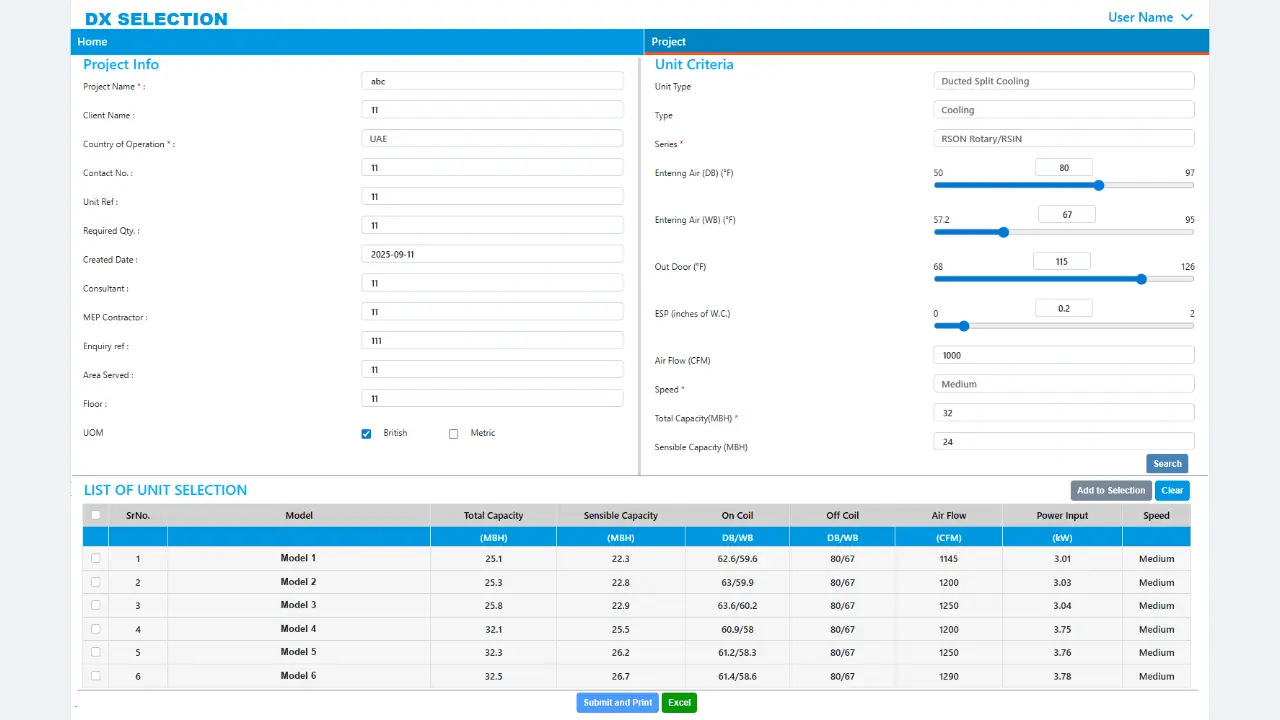
MileSoft DX Selection Software sizes direct-expansion systems — split, packaged and DX air handler equipment — for HVAC manufacturers and their application engineers. A new selection takes the required total and sensible capacity, the indoor entering condition, design airflow and outdoor ambient, and returns conforming models with project pricing, inside a project workflow that also records stage, win probability and expected close.
What separates it from a catalogue table is that the installation is an input. Equivalent line-set length and vertical rise are applied through the manufacturer's per-model coefficients, the condenser is rated at the project ambient, multi-circuit coils are solved through the shared air state rather than summed, and heat-pump capacity is reported across the winter envelope with defrost debits. The selection report states every assumption, so a reviewer can recompute the corrected capacity from the geometry.
Efficiency figures carry their rating basis: SEER2 under AHRI 210/240 below 65,000 Btu/h, IEER under AHRI 340/360 above it. DX Selection shares a project workspace with MileSoft's AHU, FCU, Chiller, ERV and Lifecycle Cost Analysis tools.
DX selection software
In a direct-expansion system, the installation is part of the machine
A DX catalogue rating describes a matched pair on a short, level line at a standard ambient. Almost no installation looks like that.
Direct expansion looks simpler than chilled water because there is no intermediate loop. That simplicity is deceptive: removing the water loop moves the refrigerant into the building, and refrigerant is sensitive to geometry in ways water is not. Suction-line pressure drop reduces compressor suction pressure and therefore capacity; vertical rise adds a static head; the condenser faces a rooftop ambient that is not the rating condition. A chilled-water system hides its installation sensitivity inside a loop a pump can be sized for. A DX system exposes it.
So equivalent line length, vertical rise, project ambient, circuit arrangement and defrost regime are selection inputs, not commissioning discoveries. A selection needs the required total and sensible capacity, the indoor entering condition, design airflow and outdoor ambient; it returns conforming models with project pricing, inside a workflow that records project stage, win probability and expected close alongside the technical selection.
Where equipment selection and services routing are done by different people at different times, the line set is fixed after the unit is chosen — precisely the wrong order. A tool that requires length and rise before it reports a capacity forces that conversation earlier.
Line-set capacity loss
What the refrigerant line set costs in delivered capacity
MileSoft's product record puts the loss at 15–25% of capacity and EER in many real installations. Here is one.
installed capacity = rated capacity × [1 − k(L) × excess equivalent length − k(H) × vertical rise]
The coefficients are per model, because they depend on line sizing, refrigerant and compressor. A tool applying one generic correction to every model produces a plausible number with no manufacturer behind it — worse than applying none, because it hides the uncertainty.
Worked example: a 30 MBH split system on a real riser
Rated at 30 MBH total and 25 MBH sensible at 1,000 cfm with a 7.5 m line. Installed at 45 m equivalent with the evaporator 18 m above the condenser, with published coefficients of 0.0022 per metre of excess length and 0.0035 per metre of rise: 30 × [1 − 0.0825 − 0.0630] = 25.6 MBH, a 14.5% shortfall. A space needing 28 MBH is satisfied on paper and under-served by 8% in practice.
The 18 m of rise cost 6.3%; the 37.5 m of extra length cost 8.3%. Per metre, vertical separation is the far more punishing variable.
Multi-circuit DX
Why two refrigerant circuits are not twice one circuit
Circuits sharing a coil face interact through the air they condition.
The air entering the second circuit's part of the coil has already been cooled by the first, so the second circuit works at a lower entering enthalpy and delivers less than its independent rating. Summing independently rated circuits overstates the assembly.
Worked example: a two-circuit coil
1.9 kg/s of air enters at 62.0 kJ/kg, and each circuit is rated at 24 kW. Summed: 48 kW. Solved in sequence, circuit 1 delivers 24 kW, the air reaching circuit 2 is at 62.0 − 24/1.9 = 49.4 kJ/kg, and circuit 2 delivers about 20.4 kW. Assembly: 44.4 kW — the sum overstated it by 8.1%. A four-circuit coil summed independently can overstate by well over 15%, and the error is largest on the largest equipment.
Line-set and circuit errors are multiplicative, not additive. A four-circuit unit on a long riser can be specified close to 25% above what it will deliver. Staging matters too: with one circuit off, the running circuit sees the whole airflow over half the active coil — the part-load case that dominates operating hours.
SEER2 vs IEER
SEER2 against IEER: the 65,000 Btu/h boundary that is not in the physics
Two DX units either side of one capacity line carry efficiency figures from different tests.
| Standard | Scope | Headline efficiency metric |
|---|---|---|
| AHRI 210/240 | Unitary air conditioners and air-source heat pumps below 65,000 Btu/h | SEER2 — seasonal cooling energy over electrical energy |
| AHRI 340/360 | Commercial and industrial unitary equipment, 65,000–760,000 Btu/h (about 19–223 kW) | IEER — integrated part-load efficiency |
Comparing a 60,000 Btu/h unit's SEER2 against a 70,000 Btu/h unit's IEER produces a ranking with no meaning, and the temptation is strongest exactly where a capacity requirement sits near the line. So every efficiency figure in a selection report carries its rating basis and capacity band rather than appearing as a bare number.
Ambient, humidity and defrost
Project ambient, the sensible split, and heat-pump defrost where it actually bites
Capacities fall with ambient, but not together; defrost peaks where people least expect it.
A candidate must meet total and sensible duty at the project's indoor entering state and outdoor ambient. Both fall as ambient rises, but total capacity falls faster because the reduced pressure difference across the expansion device cuts mass flow. The sensible ratio therefore drifts upward with ambient — favourable in a dry climate, unhelpful in a humid one. A unit meeting total duty at the wrong sensible split will not hold the space condition.
effective heating = heating at ambient × (1 − defrost duration ÷ cycle period) − defrost power
Frost forms when the outdoor coil surface is below both freezing and the dew point. Defrost frequency peaks in the humid-cold band a few degrees either side of freezing — not at the coldest design ambient. A heat pump quoted only at a low design ambient is described least well where it spends most of the heating season.
Refrigerant is the last input. Under Regulation (EU) 2024/573, in force from 11 March 2024, the HFC phase-down bites harder on DX than on chilled water because the refrigerant runs through the building: charge scales with line-set length, and so do leak-check obligations and end-of-life recovery. That belongs in any comparison of a distributed DX design against a central plant.
Why catalogue selection fails
Five failure modes of catalogue-driven DX selection
Each one makes the selected unit look bigger than the installed system will be.
Line set ignored
Capacity taken at the rated condition with no correction for equivalent length or rise — the 15–25% the product record describes.
Ambient assumed
The condenser rated at a standard ambient instead of the rooftop condition it will face; in hot climates, the larger of the two errors.
Circuits summed
Multi-circuit equipment rated as the arithmetic sum of independent circuits, ignoring the shared air-side state.
Single heating figure
Heat-pump capacity quoted at one ambient with no defrost debit, describing the hardest hours least well.
Metrics compared across the boundary
A SEER2 figure compared against an IEER figure as though they measured the same thing.
Evaluating DX software
Eight questions to put to any DX selection software
Each is answerable by demonstration — including by us.
| # | Dimension | Ask the vendor to demonstrate |
|---|---|---|
| D1 | Line set as input | Is equivalent length and vertical rise required before a capacity is reported, or applied afterwards? |
| D2 | Per-model derating | Are line-set coefficients the manufacturer's, or one generic correction for every model? |
| D3 | Project ambient | Is the condenser rated at the project's ambient or at a standard rating condition? |
| D4 | Two duties | Are total and sensible capacity both constraints, or is sensible just reported? |
| D5 | Circuit interaction | For multi-circuit equipment, are circuits solved through the shared air state or summed? |
| D6 | Part-load staging | Is the single-circuit-running case modelled, or only the fully loaded one? |
| D7 | Defrost curve | Is heating capacity reported across the winter envelope with defrost debits, or at one ambient? |
| D8 | Metric basis named | Does the report state whether an efficiency figure is SEER2 or IEER, and its capacity band? |
D1 is the fastest test. Ask for a capacity before supplying a line length. A tool that answers has not modelled the installation.
On evidence: this module appears in no published deployment case study, and no field result is claimed. MileSoft publishes an engineer-hour model — about 60 minutes per manual selection against 10 in the tool, at 30 a month, roughly 300 hours a year — and that manual baseline is a catalogue selection with an ambient correction, not one that applies per-model line-set coefficients, solves a circuit balance and builds a defrost curve. For the DX air handler question in plain terms, see DX air handler selection software.
Standards referenced: AHRI 210/240, AHRI 340/360, ISO 16358-1, Regulation (EU) 2024/573, ANSI/ASHRAE/IES 90.1, ISO 16890, ISO 5801, ISO 15686-5. Derivations are in the DX selection method paper.
Features
Key Features
Built-in capabilities that set our software apart
Line set as an input
equivalent length and vertical rise applied with the manufacturer's per-model coefficients
Project ambient
the condenser rated at the conditions it will face, not the rating point
Two duties
total and sensible capacity both required at the indoor entering condition
Multi-circuit balance
circuits solved through the shared air state, including single-circuit staging
Defrost across the winter envelope
heat-pump capacity with defrost debits, not one ambient figure
Rating basis named
SEER2 or IEER reported with its standard and capacity band
Selection with commercial context
project pricing, stage, win probability and expected close in one record
Benefits
Key Benefits
What your team gains from adopting our platform
Testimonials
What Our Clients Say
Trusted by industry leaders across manufacturing, HVAC, and logistics.
"MileSoft's product excellence and implementation are top-tier, consistently exceeding expectations. We value their dedication to solving challenges and delivering long-term solutions. After-sales support is exceptionally reliable."
FAQ
DX Air Handler & Unit Selection Software — FAQs
Answers to the most common questions about this product. Need more? Book a demo or reach out via Contact.
How much capacity does line-set length actually cost?
Why can we not compare a SEER2 figure against a catalogue rating?
Does it handle multi-circuit systems?
Does it model heat-pump defrost?
What do we hand the customer?
Is DX air handler software the same as DX unit selection?
Explore More
Related Products
Complementary tools teams often pair with this solution
Related Reading
Go deeper
Explore the long-form story behind this product.
The Installation Is Part of the Machine: Line-Set Penalty, Multi-Circuit Balance, and Defrost in Direct-Expansion Selection
Architecture, Computational Methods, and a Modelled Efficiency Case from MileSoft DX Selection Software
Read the paperRead the full DX Air Handler & Unit Selection Software for HVAC OEMs deep-dive
Read articleSee how MileSoft delivers in HVAC
Read case studySee your savings in under a minute
Estimate the time and cost this tool could give back — free, instant, no sign-up.
Give us a line length and rise, and see the real capacity
Bring a current DX selection with its installation geometry. We will show the corrected capacity, the circuit balance, and whether the efficiency figures are being compared on the same basis.