Fan Coil Unit (FCU) Selection Software for HVAC Manufacturers
Fan coil unit selection rated at each zone's actual entering air condition and noise criterion, on AHRI 440 certified performance data — so the sensible-latent split is right, and hundreds of zones are selected in one pass.
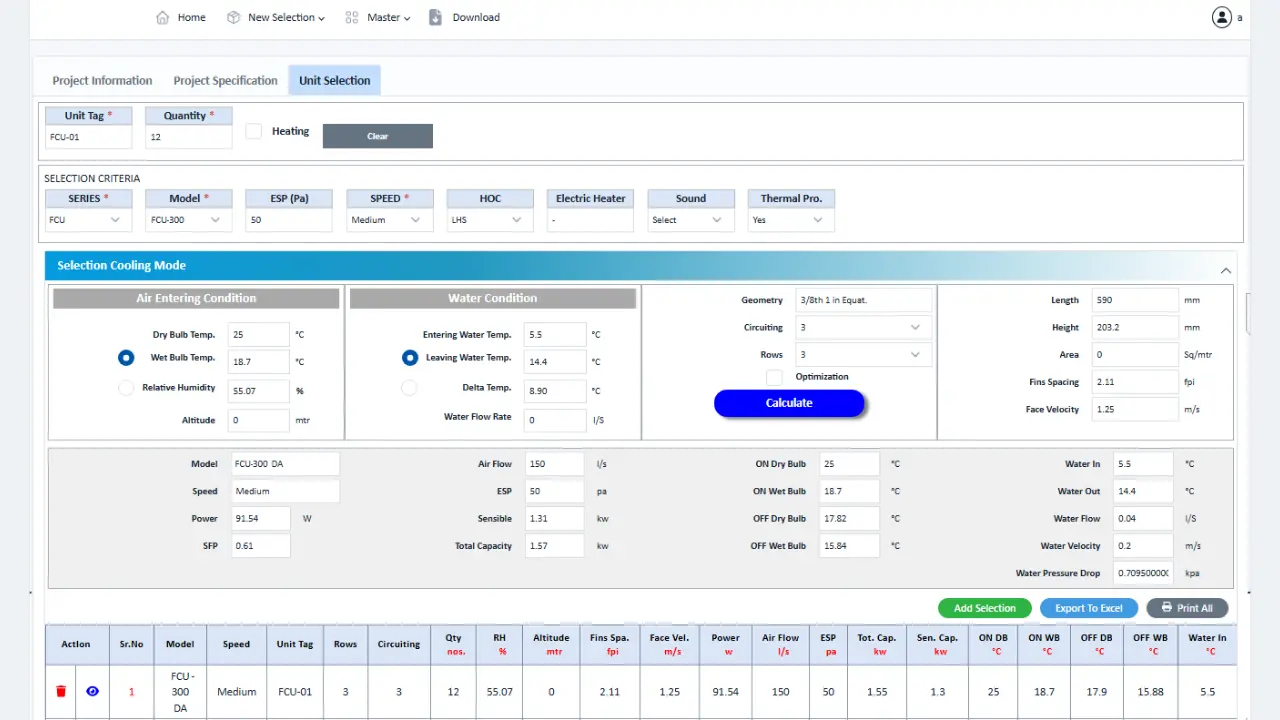
Watch with transcript →1:27 · captions · narrated demo
Software Modules
Complete FCU Software Modules
Screens from the running system — click a module to preview

Secure Login
Secure and seamless access to your projects from anywhere. Only authorized users can enter the workspace.
FCU selection on AHRI-certified data, from inquiry to report
MileSoft FCU Selection Software is built for HVAC manufacturers, MEP consultants, and system integrators who need to size and specify fan coil units across dozens — or hundreds — of zones per project without giving up engineering rigor. Every selection runs against AHRI-certified performance data, so capacity, airflow, sound, and efficiency match the published performance your tender reviewers and commissioning engineers will verify. Selections are audit-ready by default.
The tool is organized around real project workflow: capture project information and client details, define zone-level design constraints and environmental conditions, let the software recommend the best-fit FCU per zone, then compare shortlisted models side-by-side on capacity, EER, sound level, dimensions, and price. As zones get added, the project-level BOM builds automatically, consolidating across zones so procurement has a single source of truth. Clean, branded selection reports export in one click for client submission or tender response.
The platform is cloud-accessible with role-based authentication, so field engineers, office engineers, and sales can work on the same project from different locations with appropriate permissions. FCU Selection works alongside MileSoft's AHU, Chiller, ERV, DX, and Lifecycle Cost Analysis tools on a shared project workspace — so complete HVAC solutions for commercial, healthcare, and industrial buildings can be designed end-to-end in one environment. Because selecting several hundred zones correctly costs no more than selecting them from a catalogue table, the shortcut behind post-handover humidity and noise complaints stops being the economical choice.
Fan coil unit selection
Why a fan coil unit selected at the catalogue point fails two months after handover
Total capacity is usually right. The sensible-latent split is what goes wrong, and nobody diagnoses it.
Catalogue capacity is published at a reference entering condition — conventionally about 27 °C dry bulb at 50% relative humidity. Real rooms are not at the reference. Total capacity varies smoothly with entering condition and a correction factor usually catches it. The sensible-to-latent split does not: it can swing substantially for a modest change in entering wet bulb, because the share of coil surface below the dew point changes.
The failure has a recognisable shape. Nothing breaks, the plant meets duty, commissioning passes because commissioning measures temperature. Then complaints arrive about humidity or noise, in rooms sized exactly like the rooms that are fine.
Temperature complaints get diagnosed. Humidity complaints get attributed to the weather. That asymmetry is why latent under-sizing survives commissioning.
Worked example: the same unit at the catalogue point and in a real office
A four-pipe unit moves 340 m³/h, leaving the coil at 13.5 °C. At the catalogue point (27 °C, 50% RH) it delivers 2.14 kW total and 1.56 kW sensible: a sensible heat ratio of 0.73. In a perimeter office at 24 °C and 60% RH it delivers 1.77 kW total and 1.21 kW sensible: 0.68.
Total capacity fell 17% — a margin factor absorbs that. Sensible capacity fell 22% while latent barely moved. If the room needs a ratio of 0.75, the unit that looked right at the catalogue point runs longer to hold temperature and over-dehumidifies. So the selection criterion is not that total capacity suffices, but that the unit's sensible heat ratio matches the room's required one.
AHRI 440
What an AHRI 440 fan coil rating already tells you, and what table lookups discard
The certified rating states more than most selections use.
AHRI Standard 440, with AHRI 441 as its SI counterpart, sets requirements for testing and rating room fan-coil units and unit ventilators. It rates total and sensible cooling capacity separately, with power input — so the sensible-latent decomposition is part of the certified rating, not something a tool invents. A selection that reports only total capacity is throwing published information away.
It also applies only to units delivering 1,500 cfm (708 L/s) or less. Above that, equipment is rated on a different basis, which matters when a project mixes terminal units with small air handlers: two capacities quoted side by side may not mean the same thing.
Inside the unit, delivered airflow depends on the fan curve against the resistance in front of it. ISO 5801 is the basis for the fan performance the speed taps are rated against, and the filter imposes a pressure band classified under ISO 16890. Because a terminal unit has little fan pressure to spare, a unit selected on clean-filter airflow can lose a material share of its capacity before the element is changed.
AHRI certifies equipment ratings, not selection software. MileSoft FCU Selection works on AHRI 440 certified performance data.
Acoustic guardrail
Sound is a room quantity, so it is checked at selection, not at review
A unit's sound power belongs to the unit. What an occupant hears depends on the path.
AHRI Standard 885 is the industry method for estimating occupied-space sound pressure from air terminals and outlets, treating the terminal, the outlet and the connecting ductwork as sound sources along a path. Its value is that it identifies the acoustically critical path, so substituting a component can be evaluated rather than guessed.
By design review the ductwork is drawn and the only variable left is the unit — the most expensive thing to change. So the check runs during selection, as a filter rather than a warning: a candidate whose estimated space sound level breaches the zone's noise criterion is withheld, and the engineer never picks a unit a later acoustic review will reject.
Why a filter and not a flag: a warning's effectiveness depends on attention, and attention is exactly what runs out when several hundred zones must be selected before a deadline. Where a real room has absorption the model cannot know about, the criterion is adjusted per zone type with the change recorded — the default is not weakened globally.
Bulk FCU selection
Selecting four hundred fan coil units correctly for the cost of selecting them badly
The catalogue shortcut exists because doing it properly by hand takes a week no programme allows.
A four-pipe system in a mid-sized building can have several hundred terminal units across a dozen zone types. Each correct selection needs the room's sensible and latent loads, entering condition, chilled-water temperature and flow, noise criterion and physical constraints. By hand, it collapses into a table lookup — and because the same simplification is applied everywhere, the rooms that are wrong are wrong together, producing a building-wide complaint rather than a scattered one.
Room schedules import as zone lists and are selected in one pass. A zone is auto-selected only when a unit meets capacity, the sensible heat ratio within tolerance, the water-side constraints and the acoustic criterion, with margin. Any zone that does not is flagged for an engineer, never defaulted to the nearest candidate. Quantities consolidate into one project bill of materials, so procurement sees an aggregate rather than per-zone lists.
Worked example: closing the water side
The office duty of 1.77 kW at a 5 K water temperature rise needs 0.085 kg/s of water. Through a 13 mm bore that is 0.64 m/s — inside the usual 0.5–1.5 m/s band. Through a 10 mm bore it is 1.08 m/s, still acceptable; through 8 mm it reaches 1.69 m/s and the unit becomes an acoustic risk in a quiet space. That is why connection sizing is an output of selection, not a detail for later.
Why table-driven selection fails
Five failure modes of table-driven terminal unit selection
None is a matter of care. Each is built into the method.
Catalogue-point rating
Capacity is taken at the published reference condition rather than the zone's, so the sensible-latent split is wrong even where total capacity is right.
Total-capacity-only comparison
Units are shortlisted on kilowatts, discarding the sensible rating AHRI 440 already publishes.
Sound checked after layout
Acoustic performance is reviewed once ducts are drawn, when the unit is the only thing left to change.
Uniform simplification
The same shortcut applied to every room makes the wrong rooms wrong together.
Per-zone bills of material
Quantities are never consolidated, so procurement loses its volume position.
Evaluating FCU software
Eight questions to put to any FCU selection software
Each is answerable by demonstration — including by us.
| # | Dimension | Ask the vendor to demonstrate |
|---|---|---|
| D1 | Entering condition | Is the unit rated at the zone's entering state or at a catalogue reference point? |
| D2 | Sensible-latent split | Does the output state SHR, and compare it against the room's required SHR? |
| D3 | Certified basis | Are total and sensible capacity taken from an AHRI 440 rating, or interpolated from a table? |
| D4 | Acoustic constraint | Is sound a filter on candidates or a report afterwards? Try to select a unit that breaches the criterion. |
| D5 | Octave-band check | Is the acoustic comparison per band, or an A-weighted total that can hide a single-band failure? |
| D6 | Bulk correctness | Import a 400-room schedule. How many rooms are auto-selected, and how many flagged? |
| D7 | Exception honesty | Are unresolvable zones flagged, or defaulted to the nearest candidate? |
| D8 | Consolidation | Does the project bill of materials aggregate across zones, or list them separately? |
D7 is the most revealing in practice. A tool that never flags anything is not more capable than one that does; it is hiding the judgement the engineer would otherwise have exercised.
On evidence: MileSoft publishes an engineer-hour model for this module, not a measured result — 30 minutes per manual selection against 5 in the tool, at 60 selections a month, releasing about 300 engineer-hours a year. Its inputs are meant to be argued with, and it deliberately omits the hours spent resolving comfort complaints, which cannot be attributed with confidence. The HVAC case study covers a programme in which FCU Selection was one of four modules; its results belong to that programme and are not claimed here.
Standards referenced: AHRI 440 / 441, AHRI 885, ISO 16890, ISO 5801, EN 16798-3, Commission Regulation (EU) No 1253/2014, ISO 15686-5. Derivations and worked examples are in the FCU method paper.
Features
Key Features
Built-in capabilities that set our software apart
Zone entering condition
each unit rated at the room's actual dry bulb and humidity, not the catalogue reference point
Sensible heat ratio matching
the unit's SHR compared against the room's required SHR, from AHRI 440 total and sensible ratings
Acoustic guardrail
candidates that breach the zone's noise criterion are withheld at selection, following the AHRI 885 approach
Water-side closure
flow and tube velocity checked so connection sizing is an output of selection
Bulk selection
room schedules selected in one pass, with unresolvable zones flagged rather than defaulted
Side-by-side comparison
capacity margin, EER, sound level, dimensions and price across a shortlist
Consolidated bill of materials
quantities aggregated across every zone for procurement
Benefits
Key Benefits
What your team gains from adopting our platform
Testimonials
What Our Clients Say
Trusted by industry leaders across manufacturing, HVAC, and logistics.
"MileSoft's product excellence and implementation are top-tier, consistently exceeding expectations. We value their dedication to solving challenges and delivering long-term solutions. After-sales support is exceptionally reliable."
FAQ
Fan Coil Unit (FCU) Selection Software — FAQs
Answers to the most common questions about this product. Need more? Book a demo or reach out via Contact.
What is FCU Selection Software?
Is the software AHRI-certified?
Can I compare multiple FCU models side-by-side?
Does it work for projects with multiple rooms or zones?
Can we get a demo?
Explore More
Related Products
Complementary tools teams often pair with this solution
Related Reading
Go deeper
Explore the long-form story behind this product.
Rating the Terminal Unit at the Room It Serves: Sensible-Latent Split, Acoustic Guardrails, and Bulk Selection for Fan Coil Units
Architecture, Computational Methods, and Field Evidence from MileSoft FCU Selection Software
Read the paperRead the full Fan Coil Unit (FCU) Selection Software for HVAC Manufacturers deep-dive
Read articleSee how MileSoft delivers in HVAC
Read case studySee your savings in under a minute
Estimate the time and cost this tool could give back — free, instant, no sign-up.
Bring a room schedule and see which zones get flagged
Send us a real schedule. We will select it in one pass and show the sensible heat ratio per zone, the units the acoustic guardrail withheld, and the zones that need an engineer.