Chiller Selection & Configurator Software for HVAC Manufacturers
Configure and rate chillers on each manufacturer's certified performance data, with IPLV and NPLV part-load values produced in the same pass as full-load efficiency. Built for HVAC manufacturers and MEP consultants.
Watch with transcript →1:09 · captions · narrated demo
Software Modules
Chiller Selection Software Modules
Real screens from the chiller rating tool — click a module to preview

Chiller Rating
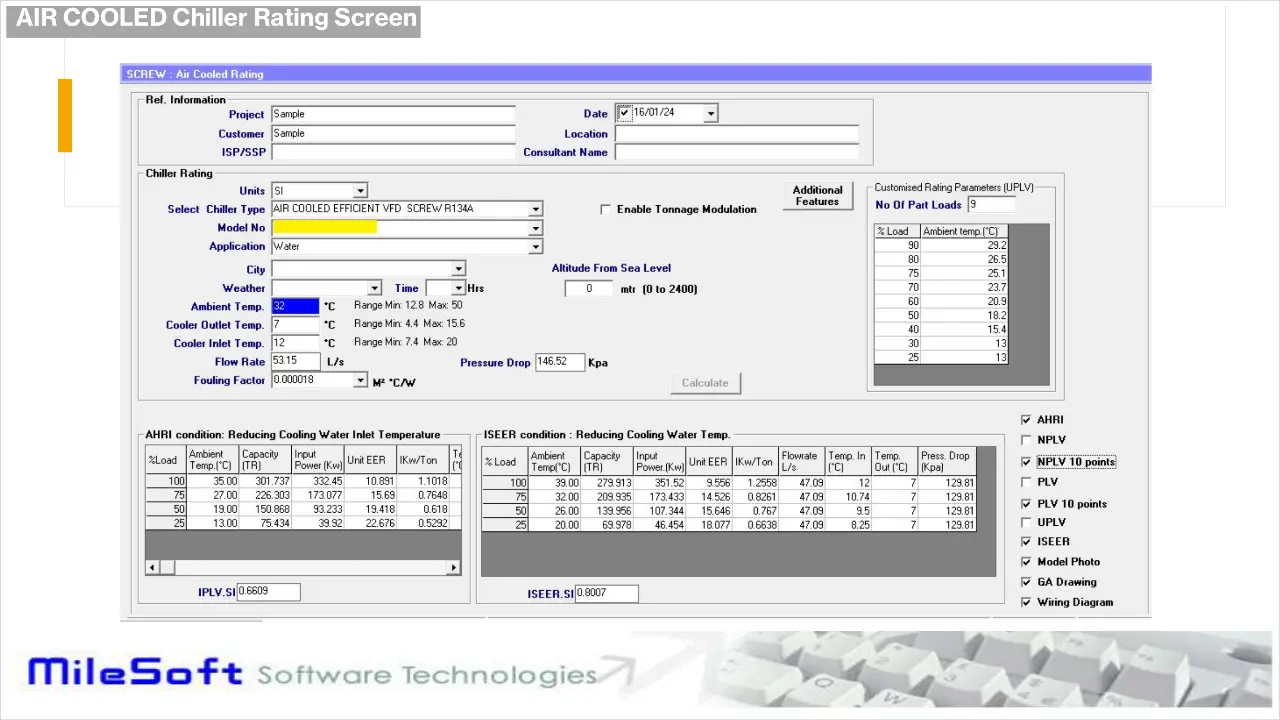
Rate a chiller at project conditions — ambient, cooler inlet and outlet temperature, flow rate and fouling factor — and read part-load capacity, input power, EER and kW/TR at AHRI and ISEER conditions, with IPLV.SI and ISEER.SI calculated and NPLV/PLV/UPLV options for the report.
AHRI 550/590-compliant chiller selection with lifecycle modeling
MileSoft Chiller Selection Software is the engineering tool HVAC manufacturers and MEP consultants use to size chiller equipment against real operating profiles, not just peak nameplate capacity. Ratings apply the ANSI/AHRI 550/590 method to each manufacturer's certified performance data, and are interpolated within that certified envelope rather than extrapolated beyond it, so selections hold up in engineering tenders, LEED documentation, and commissioning reports. The tool models both peak load and part-load performance — Integrated Part-Load Value (IPLV) and Non-Standard Part-Load Value (NPLV) — because that's where lifecycle energy cost is actually decided.
The configurator walks through project setup, cooling-load inputs, and chiller type selection (air-cooled, water-cooled, centrifugal, screw, scroll), then returns matching models with full justification: capacity at design conditions, efficiency curves, footprint, sound level, and operating range. Shortlisted chillers can be compared side-by-side, and performance differences at part-load often reverse what nameplate capacity alone suggests. A one-click branded selection report bundles equipment specs, performance curves, energy analysis, and BOM into a tender-ready PDF.
Chiller Selection sits in the same project workspace as MileSoft's AHU, FCU, DX, ERV, and Lifecycle Cost Analysis tools, so a complete HVAC solution — chiller plant plus terminal units plus energy recovery — can be designed and documented together. Integration with SAP, Oracle, and Microsoft Dynamics ERPs streams selection BOMs straight into procurement. Manufacturers, consulting engineers, and large end-users across the USA, Canada, Europe, the Middle East, and India use MileSoft Chiller Selection so that every rating a proposal quotes can be traced back to the certified data and machine version it came from.
Chiller configurator
What a chiller configurator does between your inputs and the rating
The part a datasheet cannot show you, and the part that decides whether the number is defensible.
Each machine is described by a structured master record: compressor type, refrigerant, oil, evaporator and condenser models, connection sizes and fan data; electrical and physical data; the manufacturer’s certified performance ratings; and separate multiplier sets for part-load behaviour, fan power and compressor power. Holding those separately, rather than folding them into one derating, is what lets the software reproduce a ranking reversal between an air-cooled and a water-cooled machine — fan power and compressor power move differently as load falls.
A rating run takes the project duty:
- Ambient condition
- Cooler outlet and inlet temperatures
- Chilled-water flow rate
- Evaporator pressure drop
- Fouling factor
…and returns the part-load table at 100, 75, 50 and 25% load together with full-load efficiency and both part-load values, in a single pass. Because they come from one traversal of the same map, a reviewer who recomputes any one from the others finds them consistent.
Project conditions rarely coincide with tabulated points, so capacity and power are interpolated bilinearly between the four surrounding certified values on a surface indexed by leaving chilled-water temperature and condensing temperature.
It interpolates within the certified envelope and refuses to extrapolate beyond it. A machine’s behaviour outside its certified range is not described by the data, and producing a number there would create a performance claim the manufacturer has not made. Where a project sits outside the envelope, the tool says so instead of answering.
Why datasheets mislead
Five ways datasheet-driven chiller selection goes wrong
Each is a structural gap, not a matter of care.
Full-load ranking
Machines are compared on rated kW/TR, a condition the standard's own part-load weighting assigns 0.01 of the total — and a ranking that can invert below 75% load.
Integrated value used as a project prediction
The standardised condenser trajectory is applied to a plant whose real condenser conditions differ, so the reported figure is comparable but not predictive.
Single-point comparison
Candidates are evaluated at design duty only, so a machine that is better at design and worse across the band gets selected.
Auxiliary power omitted
Condenser fan and pump power is excluded or held constant, understating the part-load penalty in air-cooled machines specifically.
Refrigerant treated as a specification
The phase-down trajectory is not carried into the comparison, so a machine's serviceability risk over twenty years is invisible at selection.
To see the first failure in numbers, the IPLV and NPLV calculator is preloaded with two machines whose ranking flips between full load and the standard’s weighted figure.
Evaluating a configurator
Eight questions to put to any chiller selection tool
Each one is answerable by demonstration against a running system — including ours.
| # | Dimension | Ask the vendor to demonstrate |
|---|---|---|
| D1 | Part-load as output | Are IPLV and NPLV produced by the same rating run as full-load efficiency, or separately? |
| D2 | Trajectory separation | Does the tool distinguish the standard condenser trajectory from the project's, and name which one applies? |
| D3 | Certified interpolation | Is efficiency computed from a certified capacity and power map, or from a coefficient applied to a headline figure? |
| D4 | Envelope refusal | Request a duty outside the certified envelope. Does the tool extrapolate, or refuse? |
| D5 | Auxiliary power | Is condenser fan and pump power modelled separately across the load band? |
| D6 | Band comparison | Compare two machines. Is the comparison shown across the load band, or only at design? |
| D7 | Refrigerant trajectory | Does the comparison carry GWP and phase-down exposure, or treat refrigerant as a specification? |
| D8 | Reproducibility | Re-rate a machine selected a year ago. Does it reproduce, with the machine data version it used? |
D4 is the most diagnostic and the least often asked. A tool that silently extrapolates beyond the certified envelope is producing a performance claim the manufacturer never made — and the output looks exactly like a legitimate rating.
Refrigerant
Refrigerant is now a selection variable, not a specification
The phase-down changes which machine is cheaper to own, not just what the label says.
Regulation (EU) 2024/573 on fluorinated greenhouse gases entered into force on 11 March 2024, repealing Regulation (EU) No 517/2014, with labelling and quota provisions applying from 1 January 2025. It tightens the phase-down of hydrofluorocarbon production and consumption in line with the Kigali Amendment to the Montreal Protocol.
For a selection, that turns refrigerant choice into an economic variable. A machine whose refrigerant faces quota contraction over the analysis horizon carries a service-cost trajectory a first-cost comparison does not show. Where a project is judged on carbon rather than energy alone, total equivalent warming impact combines both contributions:
TEWI = GWP × mrefrigerant × (leak rate × years + (1 − recovery fraction)) + years × Eannual × grid carbon intensity
The first term is refrigerant released over the machine’s life; the second is emissions from the electricity it consumes. A high-GWP machine carries a direct term a more efficient cycle may not offset — and a refrigerant facing quota contraction carries a service-cost risk that neither term captures.
Standards referenced: ANSI/AHRI Standard 550/590 (I-P) and its SI counterpart 551/591, Regulation (EU) 2024/573. The full method, with worked examples, is in the chiller selection method paper; where part-load efficiency becomes an owning cost, see HVAC lifecycle cost analysis.
Features
Key Features
Built-in capabilities that set our software apart
Rating pass
ambient, cooler inlet and outlet temperatures, flow, evaporator pressure drop and fouling factor in; part-load table, full-load efficiency, IPLV and NPLV out
Certified interpolation
bilinear across leaving chilled-water and condensing temperature, with no extrapolation beyond the certified envelope
Separate multipliers
part-load, fan power and compressor power held apart, so air-cooled versus water-cooled ranking reversals are reproduced
Band comparison
candidates compared across the load band on capacity, efficiency, footprint, sound level and operating range
Reproducible ratings
each run is stored in its project with the machine data version it used
Benefits
Key Benefits
What your team gains from adopting our platform
Testimonials
What Our Clients Say
Trusted by industry leaders across manufacturing, HVAC, and logistics.
"MileSoft's product excellence and implementation are top-tier, consistently exceeding expectations. We value their dedication to solving challenges and delivering long-term solutions. After-sales support is exceptionally reliable."
FAQ
Chiller Selection & Configurator Software — FAQs
Answers to the most common questions about this product. Need more? Book a demo or reach out via Contact.
What does MileSoft's Chiller Selection Software do?
Is the software AHRI certified?
Does it support part-load efficiency (IPLV) analysis?
Can I export a professional selection report?
How does it integrate with the rest of the HVAC suite?
What should a chiller configurator do that a datasheet cannot?
Is there a chiller configurator?
Explore More
Related Products
Complementary tools teams often pair with this solution
Related Reading
Go deeper
Explore the long-form story behind this product.
Selecting for the 95%: Part-Load Efficiency, NPLV, and Why Full-Load kW/TR Is the Wrong Metric
Architecture, Computational Methods, and Field Evidence from MileSoft Chiller Selection Software
Read the paperRead the full Chiller Selection & Configurator Software for HVAC Manufacturers deep-dive
Read articleSee how MileSoft delivers in HVAC
Read case studySee your savings in under a minute
Estimate the time and cost this tool could give back — free, instant, no sign-up.
See a chiller rated on your own machine data
Bring a recent selection. We will re-rate it across the load band, show both part-load values, and point out where the datasheet ranking and the weighted ranking disagree.